
Blanchard Court Record Confirmation
Start with the paper you were handed. Then check it against the Blanchard calendar or a clerk's reply. Court name, citation number, date, and record type should all line up. A calendar entry proves a setting exists. It does not settle what a citation, judgment, or payment record would settle. Confusing the two is how a town event notice gets mistaken for the whole municipal file.
Sometimes the clerk will say the record is a Ward 3 or district-court matter. Keep that response. It names the office that actually holds the file. Following it keeps Blanchard records accurate.
A few distinctions go a long way here. A Blanchard calendar, docket item, citation, and judgment are not interchangeable. Read a payment or fine reference separately. Keep it separate from a court setting, and keep town records apart from Ward 3 or district-court ones. If the notice and calendar disagree, ask the clerk which is current. A clerk response can also explain how to get copies. It keeps a municipal question from blurring into a parish question.
Blanchard Court Docket Searches
The official Blanchard town site posts a Mayor's Court calendar. It shows a 9:00 a.m. court time, municipal ordinance material, and a traffic fine schedule. That is the right first stop for an ordinance citation. It lacks a Caddo-wide by-name case search. Nothing there matches the District Attorney's future-date criminal search. So start with the town clerk or the Mayor's Court calendar. Do not assume a parish portal helps. It may not find a local Blanchard case.
- Read the court and issuing agency printed on the Blanchard citation or notice.
- Check the official Blanchard Mayor’s Court calendar for the local date, time, event type, and notice link.
- Save the citation number, ordinance section, approximate date, and officer or agency if known.
- Ask the town clerk whether the requested item is held by Mayor’s Court or another municipal office.
- If the document names a JP or First Judicial District court, use that custodian’s route instead.
District cases work differently. Once the court is confirmed, Caddo Clerk Connect and eClerks LA/LCRAA may help. Clerk Connect is a paid parish inquiry. Neither statewide service substitutes for a Blanchard Mayor's Court file. And a blank calendar display proves nothing about dismissal or payment.
Blanchard Mayor’s Court Calendar Records
The public Blanchard calendar is where a local record search starts. Pull down the calendar date. Note the 9:00 a.m. start time. Grab the court label, the town address, the event type, and any agenda or notice link on the official page. A calendar can show that a Mayor's Court event is scheduled. It is not a searchable list of names, case outcomes, or payment records. Those fields are not published there.
For wider context, the Louisiana Municipal Association profile for nearby Mooringsport documents a Mayor's Court and town-hall route inside the same Ward 3 area.
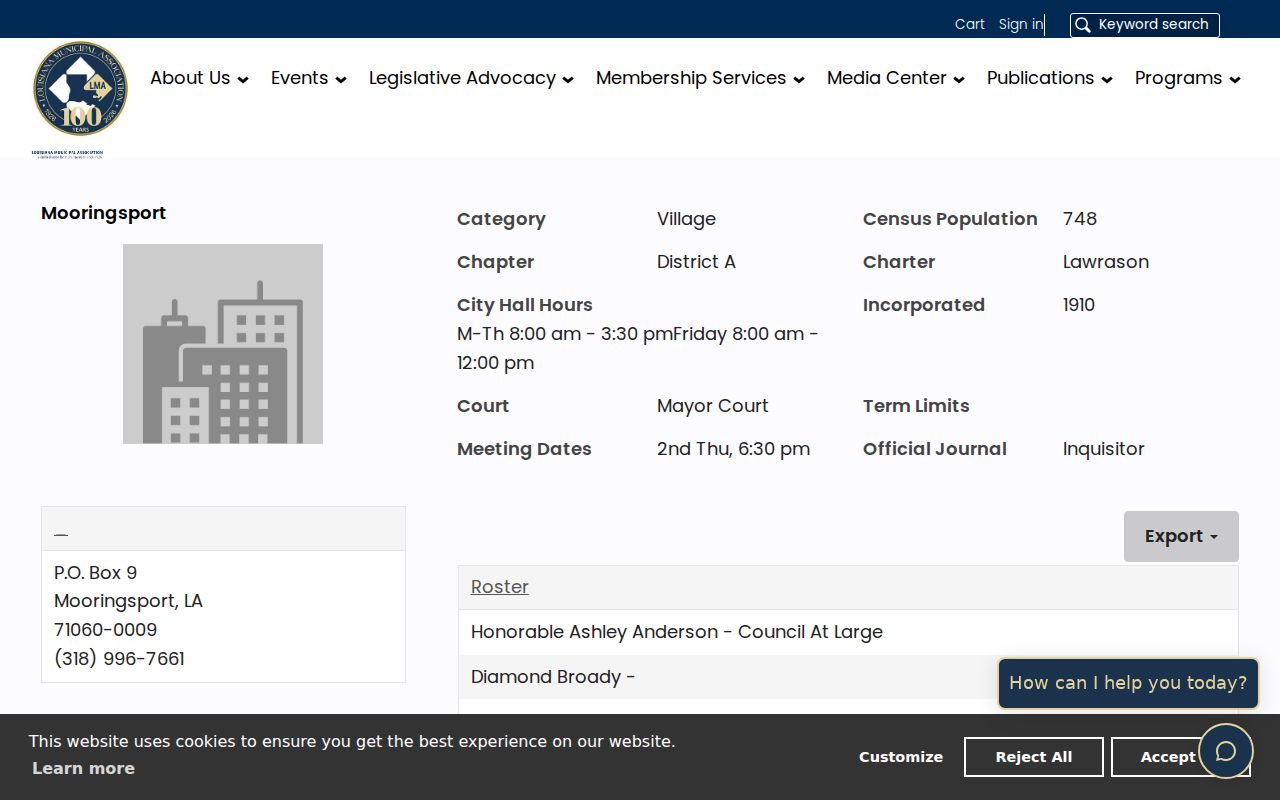
That neighboring profile is not a Blanchard docket portal. It simply shows why each town's court record must be requested from that town rather than borrowed from another Ward 3 municipality.
Inside the Blanchard Municipal Court
Blanchard Mayor's Court handles town ordinance citations and local settings. Louisiana law gives mayor's courts jurisdiction over municipal-ordinance violations, and that is the limit. A Blanchard address alone does not put every dispute there. Felonies and most higher-level criminal cases follow separate court and clerk paths. So do district civil litigation and title matters. Other First Judicial District matters take separate paths too.
For contact, the town office lists 110 Main Street, P.O. Box 428. Phone is 318-929-7593. Hours run Monday through Friday, 7:30 a.m. to 4:00 p.m. Those facts do not promise that every historical record sits online or at the counter. Ask which office holds the particular docket, citation, judgment, or disposition record. Then ask for a copy.
Blanchard Court Records Without a Name Portal
Blanchard publishes a calendar but no by-name docket search. A focused clerk request is the practical route. Name the recipient and the citation number. Add the ordinance reference, the approximate court date, and the issuing officer or agency. Say what you want. A calendar entry, a citation, a judgment, a payment record, or a disposition. Each is a different record and may sit in a different local file.
Do not swap that request for a generic Caddo search. Clerk Connect handles First Judicial District civil and criminal inquiry. Its public page says access is paid. The Caddo daily criminal docket and the DA search are separate calendar tools too. None of them is a complete Blanchard Mayor's Court archive.
Finding Blanchard Court Dates
The Blanchard Mayor's Court calendar shows a recurring 9:00 a.m. setting. That helps with planning. Still, the citation or a clerk confirmation remains the best source for a particular matter, because a continuance, a changed setting, or a compliance event can change what the entry means. When paperwork and calendar disagree, call the town clerk.
| Date | The Mayor’s Court calendar date or the date on the Blanchard notice. |
|---|---|
| Time | The published 9:00 a.m. court time or the individual time confirmed by the clerk. |
| Courtroom | The municipal location shown in the current Blanchard court notice or calendar. |
| Judge | The official who presides if listed on the present record; do not infer it from a calendar. |
| Setting Type | Mayor’s Court, ordinance, traffic, compliance, or another event actually identified by the town. |
Note where a posting came from and the date it was checked. A calendar tells you when an event is set, not how a case ended, moved, or got reset.
Blanchard Ordinance and State Traffic Records
Blanchard municipal ordinance cases run through the town's Mayor's Court. State-law traffic tickets are different. The route depends on the agency that wrote the ticket, even if the stop happened inside Blanchard. The Caddo DA traffic division sends tickets from listed non-Shreveport agencies through its traffic process. Shreveport Police tickets go to City Court instead. So read the court line printed on the ticket. The town name alone does not settle it.
The fine schedule on the Blanchard site is municipal guidance only. It cannot set the amount, due date, or court for another agency's citation. Rely on the paper itself and that agency's official route. Keeping these lanes straight stops a town schedule from being mistaken for a parish traffic docket, or a parish form from being treated as a Blanchard ordinance record.
Blanchard Traffic Ticket Lookups
Start with the ticket itself. Was it written under a town ordinance or state law? Which officer or agency issued it? A town ordinance citation belongs with the Mayor's Court calendar and clerk. For a Caddo state-traffic matter, the DA's official traffic route can supply court dates, extensions, and pretrial information. It is subject to its own rules. One payment channel rarely covers both.
The Caddo traffic page lists the Sheriff's payment and contact routes for DA-handled matters. It is not a Blanchard court archive. The town clerk can tell you whether a local record sits with Mayor's Court. Or the clerk may point you to another municipal office. Whether paying or contesting, follow the notice you received. Then confirm the deadline with the court named on it.
Blanchard Ward 3 Justice Court Records
Ward 3 is its own Blanchard-area route. Caddo's official Justice of the Peace list maps west-central Blanchard and Mooringsport to Ward 3. It names Brian K. Anderson at 318-464-2053. Under Louisiana Code of Civil Procedure art. 4912, qualifying justice courts may hear movable-property cases up to $5,000. They also handle eviction matters. That is not the Mayor's Court ordinance lane.
Treat the JP directory as a geographic routing reference, not a live docket search. Confirm the current office and the court named on your papers. Do that before sending a request anywhere. A limited civil or eviction record may sit with the Ward 3 justice court. A town ordinance record belongs to Blanchard. A larger civil case belongs in First Judicial District Court.
How Blanchard Cases Reach the County
A Blanchard case reaches parish court only when the claim, charge, or subject outgrows the municipal or justice-court lane. The First Judicial District Court for the Parish of Caddo is the general-jurisdiction trial court. Its clerk is Mike Spence, the Caddo Parish Clerk of Court. His office keeps that court's civil, domestic, criminal, appellate, and minute records. Those files are separate from Blanchard Mayor's Court records.
Docket flow: Blanchard Mayor’s Court or Ward 3 Justice Court › Caddo Parish court routes › First Judicial District Court for the Parish of Caddo
Once a Blanchard matter reaches district court, you can research it through the proper Caddo clerk channel. A current setting may also show up in the Daily Criminal Docket or the DA future-date search for adult district criminal cases. Neither tool turns a town citation into a parish record after the fact.
Blanchard Court Record Request Checklist
A good Blanchard request is specific. Name the person or business, the citation or case number, and the ordinance section or violation. Add the approximate date, the issuing agency, and the exact record you need. Say whether you want a plain copy, an inspection, payment status, disposition, or a certified record. Ask if the town offers electronic delivery or an inspection appointment. Another approved way to get a copy may also exist.
If Blanchard points you to the Caddo clerk, keep the referral. Work with the parish custodian. The clerk's district-court request route asks for a defined record, a date range, and the docket number when known. A request for everything slows identification down. A focused one makes the right municipal or parish file far easier to locate.
Who Can See Blanchard Court Records
Louisiana public-record law gives a general right to inspect or copy public records, within statutory exceptions. It does not promise full openness. Not every Blanchard docket, personal detail, juvenile matter, sealed record, or expunged file will be public. Ask the town custodian what can be inspected or copied. Ask which rule applies when something is withheld or redacted.
For a Blanchard municipal request, start with the town clerk rather than a district-court statute alone. For a First Judicial District record, the Caddo clerk is the custodian. The right custodian can explain what the item is. It may be a public index, a docket or calendar entry, a document image, a certified copy, or a restricted file.
Key Rules:
Louisiana Public Records Law gives adults a general right to inspect or copy public records unless an exception applies.
Louisiana Code of Civil Procedure art. 251 makes the clerk the custodian of court records and permits public examination or copies as allowed by law.
Louisiana Code of Civil Procedure art. 253 applies comparable court-record access principles to filed electronic documents.