
Caddo Parish Court Record Requests
First Judicial District Court files live with the Caddo Parish Clerk of Court, Mike Spence. That office holds civil, domestic, criminal, appellate, and minute records for the district. Before you call, know what you want. A docket or index is one thing. A minute entry, a filed image, a paper file, a transcript, and a certified copy are each their own request. Not every Caddo Parish matter sits in that office. A city court, juvenile court, justice-of-the-peace court, mayor's court, or federal file may sit elsewhere. Each of those can answer to a different keeper.
- Write down the exact case number, party names and roles, division or section if known, and the filing or hearing date range.
- Name the specific item needed, such as a judgment, minute entry, petition, docket printout, document image, or transcript.
- Choose the channel that matches the record: Caddo Clerk Connect, eClerks LA, direct copy request, the public counter, or the court that keeps the file.
- Ask for electronic delivery if it is acceptable and state whether certification is needed before the Clerk calculates any copy or postage charge.
- Keep the written request and the custodian's response, especially when an item is unavailable, partly redacted, or restricted.
Clerk Connect is the paid parish inquiry for Caddo civil and criminal records. For statewide and parish services, eClerks LA is the other route. Its offerings vary by record type. The Clerk's office also takes direct copy requests. You can go in person, call, email, mail, or use a limited fax option. The public materials do not state how many public terminals exist. Nor do they say whether any feature is terminal-only. Ask the staff in Room 103 which access method applies right now.
Caddo Court Record Request Channels
Different channels answer different questions. The Clerk's Web Inquiry page points to Caddo civil and criminal inquiry services. The direct copy route, though, works only when you already know the record you want. It is not a general search. Check the court named on the case paper first. That tells you whether the Clerk is the right office before you send anything.
| Channel | Best Use | Documented Contact or Limit |
|---|---|---|
| Clerk Connect and eClerks LA | District-court inquiry, statewide indexes, participating criminal-minute access, and available images. | Clerk Connect is account-based; statewide and parish eClerks options do not expose the same records. |
| Room 103 counter or phone | Inspection, record-layer questions, copies, and an official follow-up. | Civil filings: 318-226-6776; civil copies: 318-226-6791; civil and domestic minutes: 318-226-6785; criminal minutes: 318-226-6786. |
| Email, mail, or copy fax | Defined copy or public-record requests when a portal result is insufficient. | copies@caddoclerk.com; civil@caddoclerk.com; criminal@caddoclerk.com; copy fax 318-629-1105. Mail uses 501 Texas Street, Room 103, Shreveport, LA 71101. |
The eClerks LA contact page shows how LCRAA support sorts a question by parish, contact, and the details of what you need.
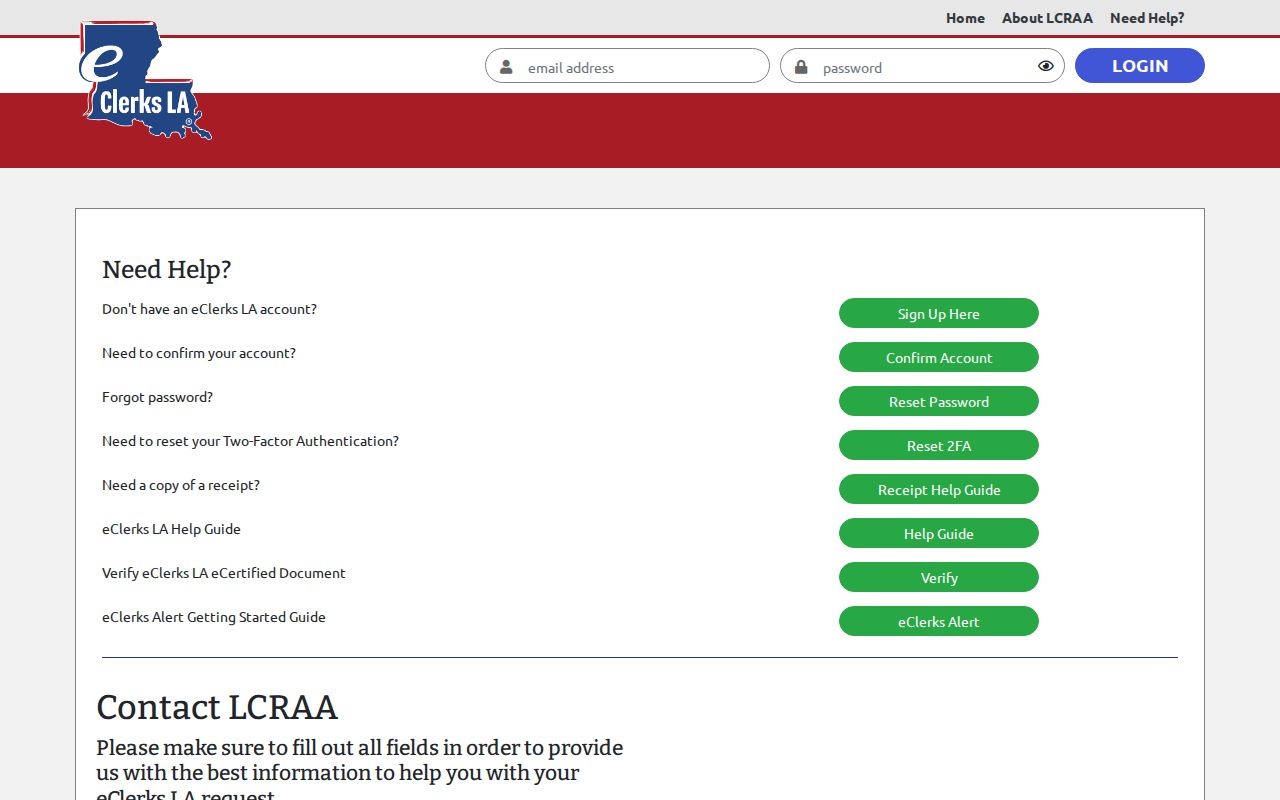
Write down the service and record type before you contact support. A statewide portal issue, a Caddo Clerk Connect question, and a straight copy request each go to a different place.
Kinds of Court Records
The category of record decides who keeps it and what you can ask for. Caddo's Clerk splits its services into civil, domestic, criminal, minute, land, and marriage. A court docket works like an index of procedure. A filed image, a certified copy, and a transcript are separate products with separate steps. Do not assume municipal, juvenile, justice-of-the-peace, or federal records sit in the First Judicial District Court file. They usually do not.
- District civil and domestic indexes, pleadings, motions, orders, judgments, and notices
- Criminal case indexes, charging filings, minutes, and public disposition material
- Daily criminal calendar entries and next-setting information, which are not the complete file
- Certified civil or criminal copies and separately requested transcripts
- Land records, mortgages, conveyances, and recorded instruments, which are distinct from a civil pleading
- Marriage records, juvenile files, City Court material, justice-court files, and federal filings held by their own custodians
Caddo Court Record Layers
Pick the right layer and you avoid a vague request for "everything." The public index finds the case. The minute or docket entry says what happened in it. A filed image gives you the text of a paper or electronic filing. Access rules decide when that is possible. Certification and transcripts each need their own request.
- Index or docket
- A finding tool listing case identifiers and procedural entries. It may omit images, exhibits, and later changes.
- Minute entry
- The court's procedural notation of an event. It can describe a hearing or ruling without reproducing every underlying document.
- Filed image
- The scanned or electronic copy of a pleading, order, or other paper, if the system makes it available.
- Certified copy
- A clerk-authenticated reproduction. Certification is not notarization and does not guarantee every attachment is included.
- Transcript
- A separate product that may require the court reporter or the Clerk's transcript-copy route.
Court Records: What They Contain
A Caddo case file can hold much more than a docket sheet. What is inside depends on several things. The case type matters, and so does its age. The access rules apply too. So does whether a document was filed, scanned, or restricted. Read the event label and the record type side by side. A charge is only an allegation until a later adjudication or disposition says otherwise. A calendar setting is a date, not a completed hearing.
| Case Number | The primary identifier. Use its exact punctuation and sequence when a request or portal allows it. |
|---|---|
| Pleadings | Petitions, answers, exceptions, motions, oppositions, memoranda, charging papers, or other case filings. |
| Orders and Judgments | Signed rulings, notices of judgment, scheduling orders, and other court action where publicly available. |
| Docket and Minutes | Chronological procedural entries that identify filings, settings, hearings, rulings, or dispositions. |
| Exhibits and Evidence | Items that may be stored separately, unavailable online, redacted, restricted, or subject to a different access rule. |
| Source and Date | The portal or office used and the date of access, which help distinguish a live calendar result from historical case material. |
Caddo Digital Record Limits
Caddo's record systems did not all start at once. Criminal case information has been indexed on computer since 1980. Civil indexing began in 1982. Scanning of civil filings started in 2002. Older civil files are still being backscanned so that coverage reaches further back, and criminal minutes go back to 1984, with criminal documents reaching 2002. So an older file can exist even when its image is missing from a current search. Clerk Connect, eClerks LA, and electronic filing widen access, but none of them promise that every historical image, document type, court division, or restricted record can be viewed without login or payment. Ask the Clerk whether an older item sits in a paper archive, on microfilm, in another index, or in the backscan queue.
Copy Fees and Certification
Online inquiry copies and direct Clerk copies carry different published prices. Caddo Clerk Connect charges $0.60 per page for web-inquiry copies, plus a 3.45% third-party card convenience fee. Go through the Clerk directly instead. The copy page lists $1 per page no matter how it is delivered. Postage is added when mailed. Under the criminal fee schedule, each certified copy adds $5. Check the current fee, record type, and delivery method before you pay. A civil image, a criminal minute, a transcript, and a certified document may not travel the same route.
| Item | Published Amount |
|---|---|
| Clerk Connect web-inquiry copy | $0.60 per page, plus the listed 3.45% card convenience fee |
| Direct Clerk copy | $1 per page, plus postage when mailed |
| Electronic direct-copy calculation | 55 index records count as one page |
| Criminal certification | $5 per certified copy, in addition to the criminal copy charge |
| Criminal transcript copy | $1 per page, subject to the appropriate transcript route |
Caddo Parish Clerk of Court
501 Texas Street, Room 103
Shreveport, LA 71101
Civil filings: 318-226-6776
Civil copies: 318-226-6791
Civil and domestic minutes: 318-226-6785
Criminal minutes: 318-226-6786
Code of Civil Procedure art. 251 spells out the rules. It separates simple public examination from plain copies and certified copies of court records.
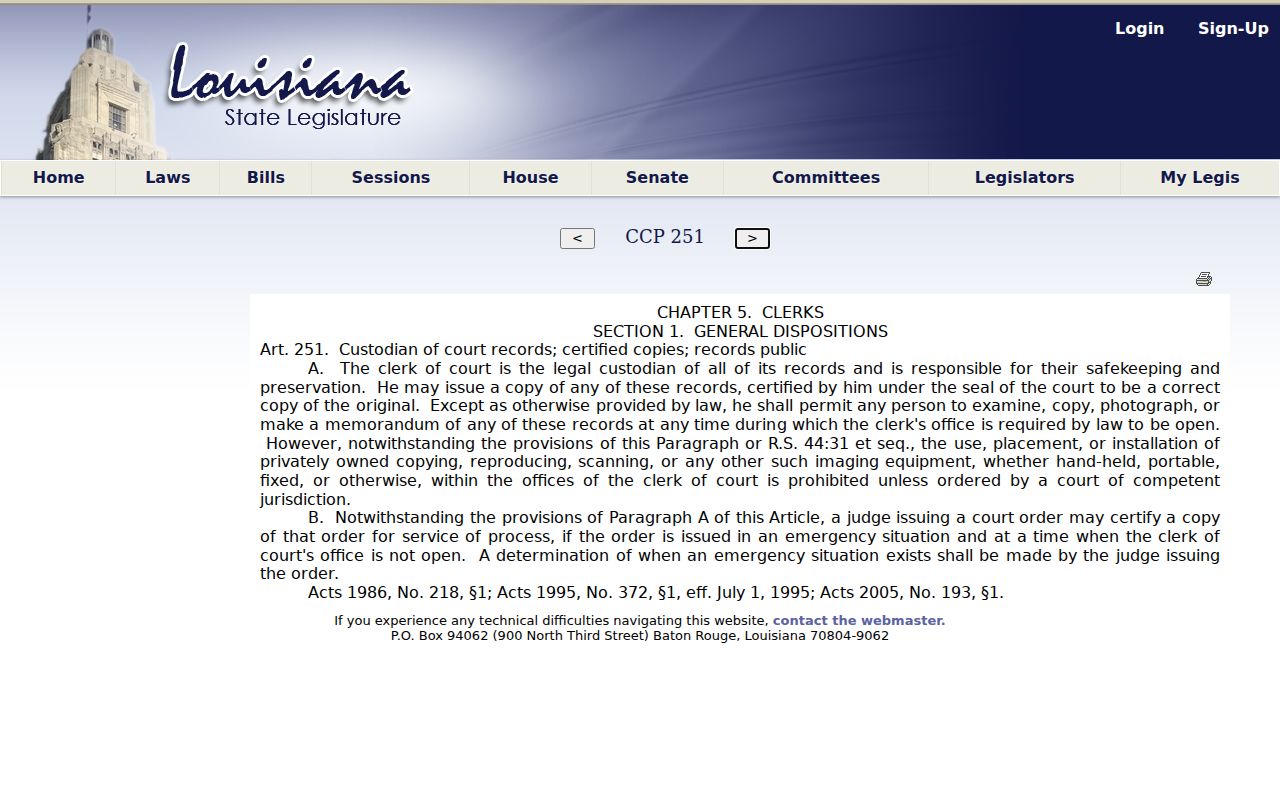
A certified copy from the Caddo Parish clerk carries a seal that proves it matches the official court record. Certification changes nothing about access. It cannot open a restricted file to the public or turn a portal printout into the complete case docket.
Caddo Record Request Routing
Big Act 654 requests take a written route. Send criminal matters to the Caddo Parish Clerk of Court, Attention: Dianne Doughty, Public Records Request, 501 Texas Street, Room 103, Shreveport, LA 71101, or Dianne.Doughty@caddoclerk.com. Route any other large request to Attention: Mike Spence at the same address, or Mike.Spence@caddoclerk.com. The official request page gives instructions only. It offers no form fields. It posts no response deadline either. With no form and no posted deadline, the letter itself carries the weight.
A tight request earns faster answers. Name the record type and the exact docket number, list party names and their roles, add the division if known, and give a date range. State your delivery preference, whether you need certification, and that you will pay lawful charges. If an item is withheld or delayed, keep your copy of the request and ask for the statutory basis plus any segregable public portion. Check the Clerk's current delivery instructions before mailing original papers.
Access Rules for Court Records
Two statutes govern access here. Louisiana R.S. 44:31 grants the general right to examine, copy, or reproduce public records, subject to statutory exceptions. Code of Civil Procedure art. 251 names the clerk as custodian of court records and allows public examination or copies during office hours, as law and court rules permit. Electronic filing only changes the delivery format. The rules on confidentiality, sealing, and redaction stay the same.
Key Rules:
Louisiana R.S. 44:31 creates the general public-record examination and copying baseline, subject to exceptions.
Code of Civil Procedure art. 251 names the clerk as custodian and addresses court-record examination, copying, and certification.
Code of Civil Procedure art. 253 treats e-filed pleadings as court records with the applicable public-access treatment.
Louisiana R.S. 13:754 describes the Louisiana Clerks' Remote Access Authority's remote-access and electronic-filing framework.
Louisiana R.S. 13:5992 requires qualifying criminal minute-entry access or summaries for cases filed on or after January 1, 2020, but not every document and not traffic records.
The R.S. 13:5992 text is the official authority on which criminal minute entries qualify.
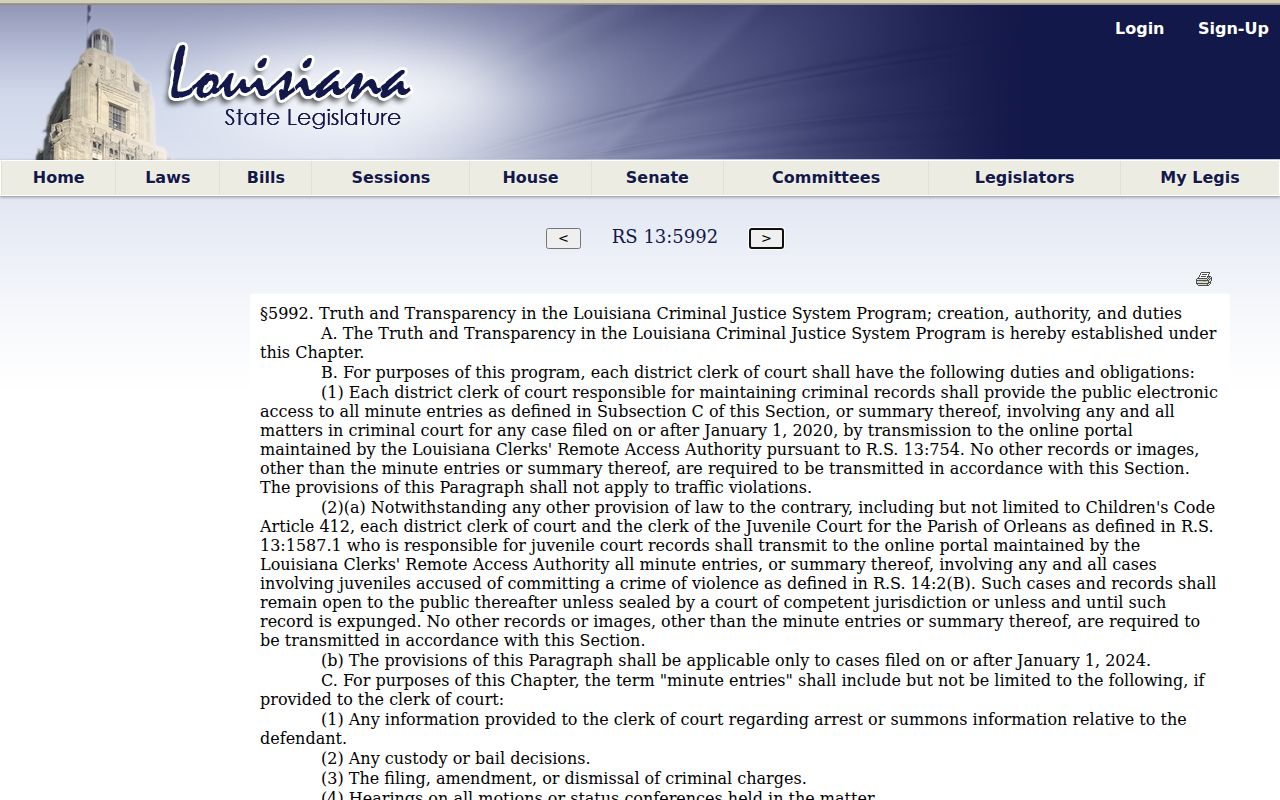
A public minute-entry layer gives you procedural history and nothing more. It does not guarantee a free download of every charging instrument, exhibit, transcript, judgment image, or other document in a case.
Caddo Restricted Record Limits
Some Caddo court records sit behind locks. Juvenile records are generally confidential under Children's Code art. 412, and juvenile matters go to the Juvenile Clerk rather than the adult district record system. Expunged records are confidential under Code of Criminal Procedure art. 973. A sealed order, protected address, medical material, discovery item, grand-jury matter, or domestic attachment may be unavailable or only partly available. The index can even show a generic entry. The document image stays restricted.
A blank result proves nothing. Treat an unavailable record as just that, not as proof that no proceeding exists. Read the access notice. Then ask the proper clerk division whether authorized inspection, a redacted copy, or certification is possible. When something is withheld, request the rule or statute behind the decision. Ask too for the public portion that can be separated from protected information.